Portrait of Pei Zhou by the waterfront

Generalist embodied systems and agentic robot learning

Pei Zhou | 周佩

Ph.D. Candidate, Institute of Data Science,
The University of Hong Kong

I study scalable generalist embodied systems, with a focus on conditional policy learning, parameter generation, and agentic execution for robust long-horizon tasks.

I build policy systems for robots that need to reason, act, and recover.

My research focuses on building scalable generalist embodied systems that can adapt across tasks, environments, and embodiments. I am especially interested in conditional policy learning, parameter generation, and agentic systems for robust long-horizon tasks.

More broadly, I am interested in how unified learning architectures can organize heterogeneous embodied experience across interaction, visual dynamics, and language-grounded feedback into scalable objectives for agents that perceive and act in the physical world.

Current focus

Agentic robot learning

Designing execution loops where robots plan, act, verify outcomes, diagnose failures, and improve through feedback-driven interaction.

Conditional generalist policies

Learning policies that adapt from goals, instructions, observations, and embodiment context while preserving a shared, reusable policy core.

Parameter generation

Treating adaptation as the generation of task- or context-specific policy parameters, connecting hypernetworks, optimization, and embodied control.

Selected publications

Representative work on embodied agents, policy generation, concept discovery, and language-grounded manipulation.
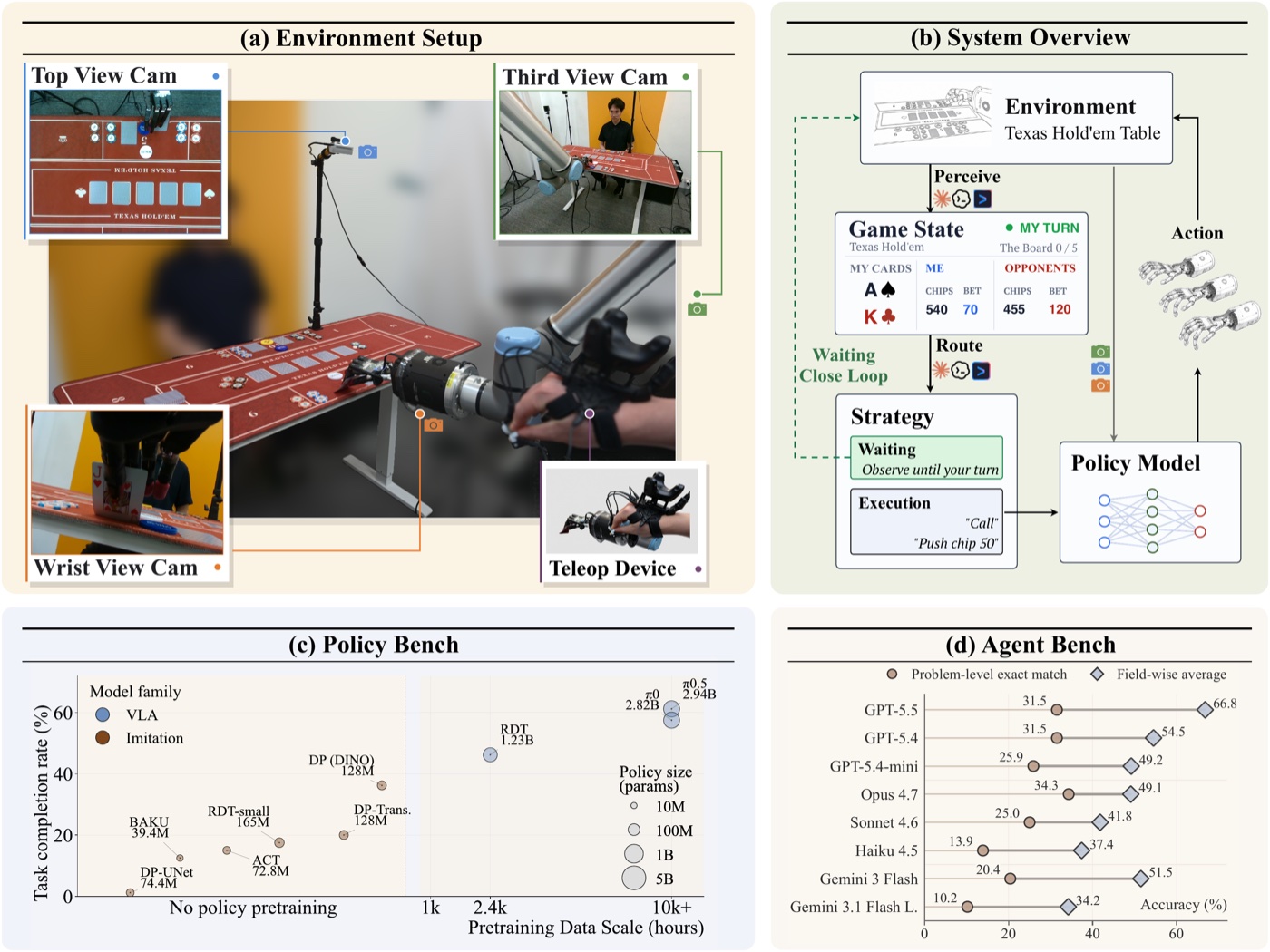
DexHoldem system teaser showing poker-table perception and dexterous card manipulation

arXiv 2026 / Under Review

DexHoldem: Playing Texas Hold'em with Dexterous Embodied System

Feng Chen*, Tianzhe Chu*, Li Sun*, Pei Zhou*, Zhuxiu Xu, Shenghua Gao, Yuexiang Zhai, Yanchao Yang, and Yi Ma

Builds an agentic system that plays Texas Hold'em in the physical world, turning card-chip perception, decision routing, and dexterous actions into a benchmark.

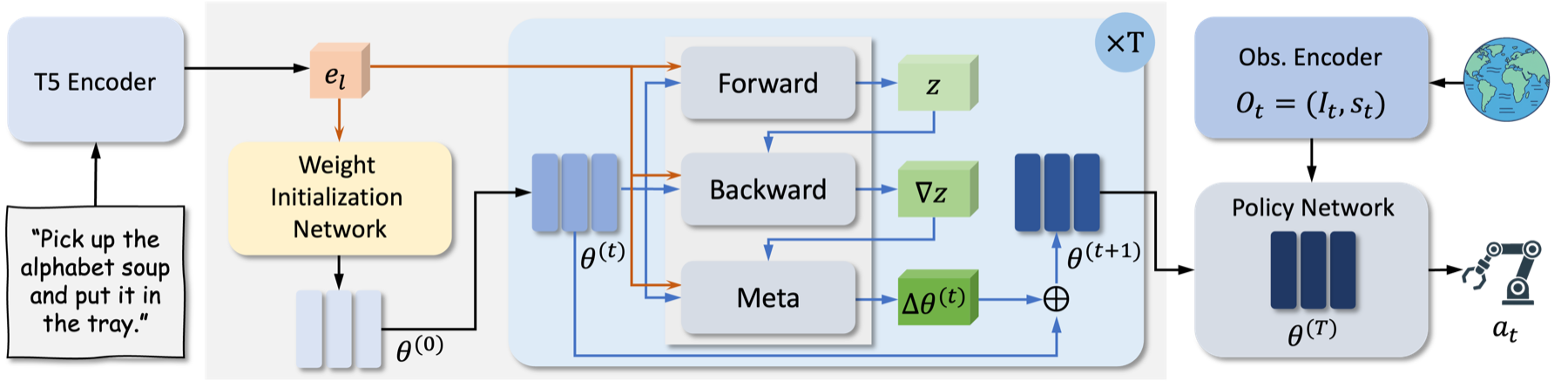
DISC overview diagram for decoupling instruction from state-conditioned control

RSS 2026

DISC: Decoupling Instruction from State-Conditioned Control via Policy Generation

Hanxiang Ren*, Pei Zhou*, Xunzhe Zhou, and Yanchao Yang

Decouples language-conditioned policy generation from vision-action control, reducing shortcuts where policies exploit visual-action correlations and ignore instructions.
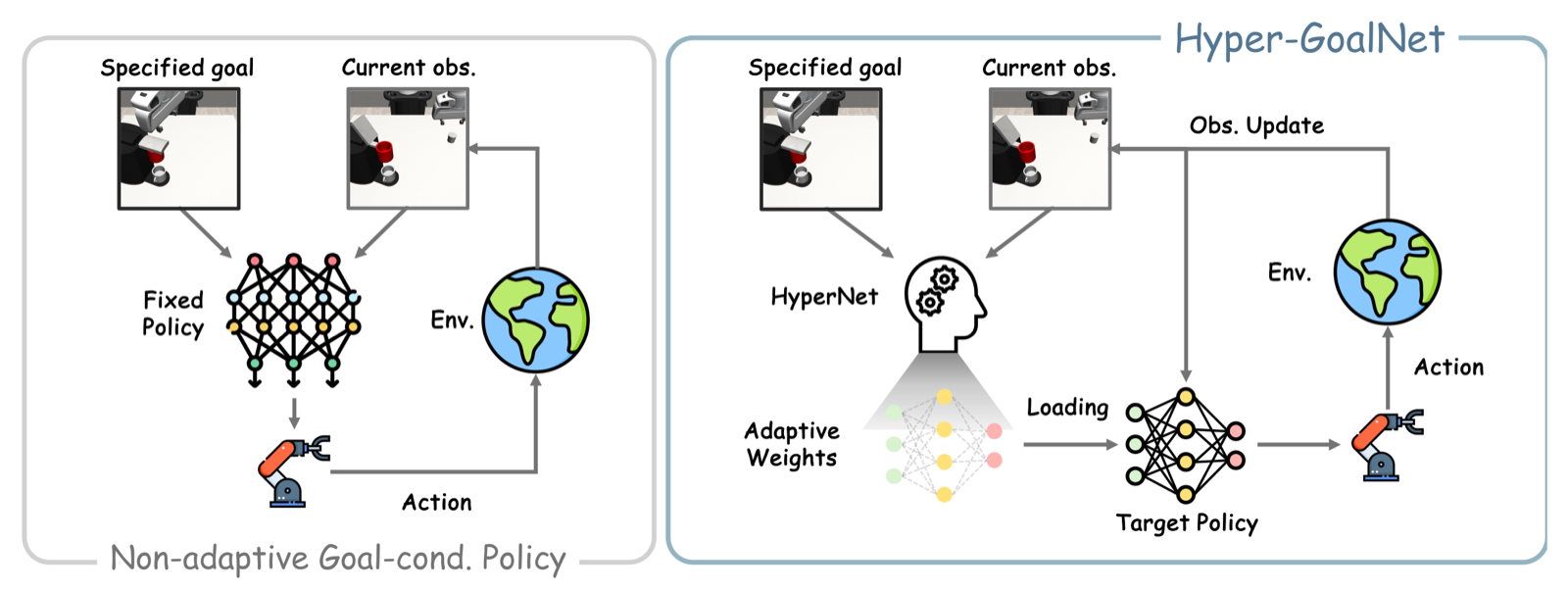
Hyper-GoalNet teaser diagram for goal-conditioned policy generation

NeurIPS 2025

Hyper-GoalNet: Goal-Conditioned Manipulation Policy Learning with HyperNetworks

Pei Zhou, Wanting Yao, Qian Luo, Xunzhe Zhou, and Yanchao Yang

Generates goal-specific policy parameters and distance-aware representations so each policy adapts to its visual goal and estimates whether execution has reached it.

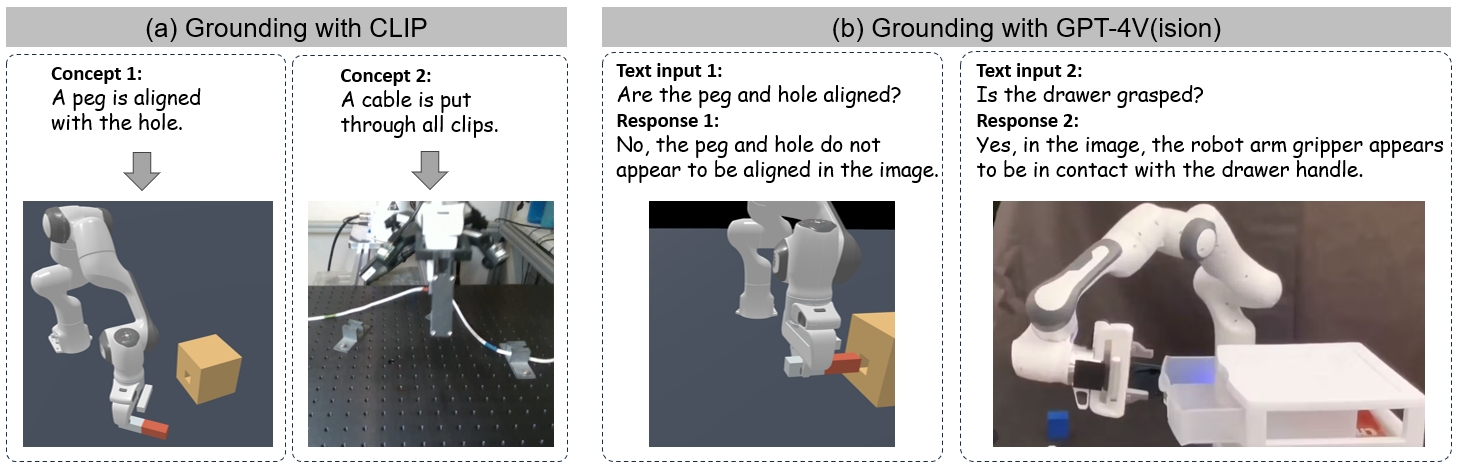
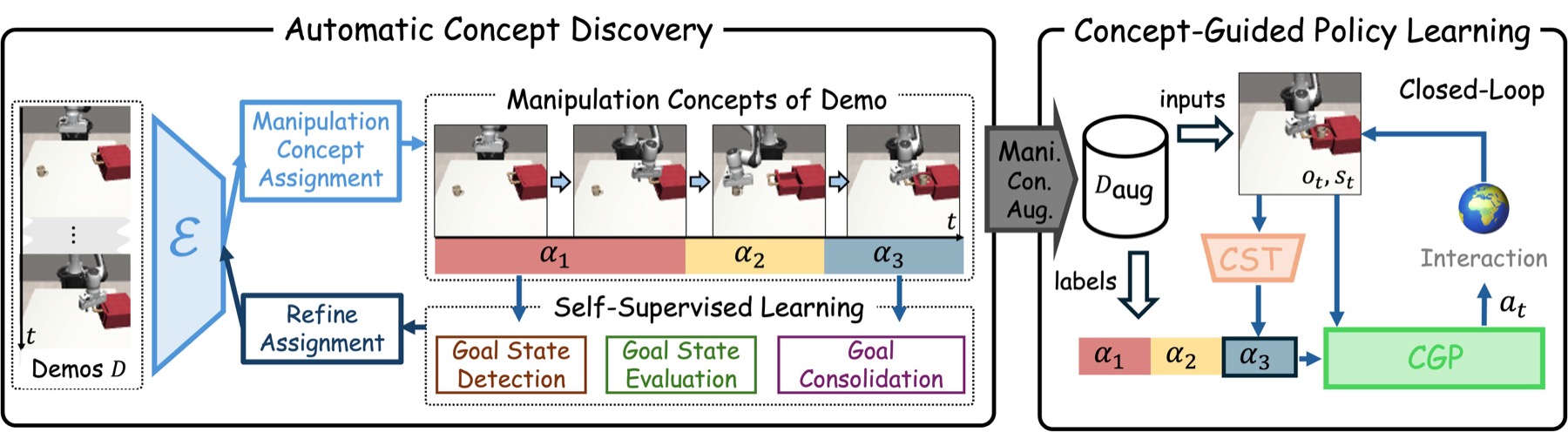
AutoCGP teaser showing concept-guided policies from demonstrations

ICLR 2025 Spotlight

AutoCGP: Closed-Loop Concept-Guided Policies from Unlabeled Demonstrations

Pei Zhou*, Ruizhe Liu*, Qian Luo*, Fan Wang, Yibing Song, and Yanchao Yang

Discovers task events and subtask-level manipulation concepts from unlabeled demonstrations, then selects concepts online to switch behaviors during visuomotor execution.

MaxMI overview figure for manipulation concept discovery

ECCV 2024 Oral

MaxMI: A Maximal Mutual Information Criterion for Manipulation Concept Discovery

Pei Zhou and Yanchao Yang

Defines an information-theoretic criterion to discover manipulation concepts, enabling policies to predict future key states and final states during online execution.

Publication list

Under Review

  1. DexHoldem: Playing Texas Hold'em with Dexterous Embodied System. Feng Chen*, Tianzhe Chu*, Li Sun*, Pei Zhou*, Zhuxiu Xu, Shenghua Gao, Yuexiang Zhai, Yanchao Yang, and Yi Ma. arXiv, 2026. Project Paper Code

Published and Accepted Papers

  1. DISC: Decoupling Instruction from State-Conditioned Control via Policy Generation. Hanxiang Ren*, Pei Zhou*, Xunzhe Zhou, and Yanchao Yang. Robotics: Science and Systems, 2026. Paper Code
  2. Hyper-GoalNet: Goal-Conditioned Manipulation Policy Learning with HyperNetworks. Pei Zhou, Wanting Yao, Qian Luo, Xunzhe Zhou, and Yanchao Yang. NeurIPS, 2025. Paper Code
  3. AutoCGP: Closed-Loop Concept-Guided Policies from Unlabeled Demonstrations. Pei Zhou*, Ruizhe Liu*, Qian Luo*, Fan Wang, Yibing Song, and Yanchao Yang. ICLR, 2025. Spotlight. Paper Code
  4. MaxMI: A Maximal Mutual Information Criterion for Manipulation Concept Discovery. Pei Zhou and Yanchao Yang. ECCV, 2024. Oral. Paper Code
  5. HiMaCon: Discovering Hierarchical Manipulation Concepts from Unlabeled Multi-Modal Data. Ruizhe Liu, Pei Zhou, Qian Luo, Li Sun, Jun Cen, Yibing Song, and Yanchao Yang. NeurIPS, 2025. Paper Code
  6. HyPoGen: Optimization-Biased Hypernetworks for Generalizable Policy Generation. Hanxiang Ren, Li Sun, Xulong Wang, Pei Zhou, Zewen Wu, Siyan Dong, Difan Zou, Youyi Zheng, and Yanchao Yang. ICLR, 2025. Paper Code
  7. SPEAR: Selective Preference Elicitation with Adaptive Rewards for VLM-Guided Robotic Manipulation. Zewen Wu, Ruizhe Liu, Pei Zhou, Feng Chen, and Yanchao Yang. IROS, 2026.
  8. Geometric Entropy: When Trajectory Diversity Helps and Hurts in Imitation Learning. Qian Luo, Ruizhe Liu, Pei Zhou, Xunzhe Zhou, and Yanchao Yang. IROS, 2026. Paper Project Code Coming Soon
  9. Learning Human-Humanoid Coordination for Collaborative Object Carrying. Yushi Du, Yixuan Li, Baoxiong Jia, Yutang Lin, Pei Zhou, Wei Liang, Yanchao Yang, and Siyuan Huang. ICRA, 2026. Paper Project Code

Education

2023-2027 expected

The University of Hong Kong

Ph.D. Candidate, Institute of Data Science

Supervisor: Prof. Yanchao Yang

2021-2023

University of California San Diego

Master of Science in Electrical and Computer Engineering

2017-2021

Fudan University

Bachelor of Engineering in Electrical Engineering

Honors and awards

  • 2023 Best Poster Presenter Award, The University of Hong Kong Summer Research Program
  • 2023 Outstanding Graduate, University of California San Diego
  • 2021 Outstanding Graduate, Fudan University
  • 2019-2020 First-Class Scholarship, Fudan University
  • 2019-2020 Best 10 Students Award, School of Information Science and Engineering, Fudan University

Open to research conversations on robot learning and embodied agents.